VALEXII Research / Rongorongo · Not deciphered
Rongorongo: the undeciphered glyphs of Rapa Nui
Carved signs invite a reading; object context and independent evidence must constrain it. Explore the surviving record, the Mamari calendar debate and VALEXII’s unverified computational research questions.
Research in progress — not a claimed decipherment.
Background and research status
Frequently asked questions
- What is Rongorongo?
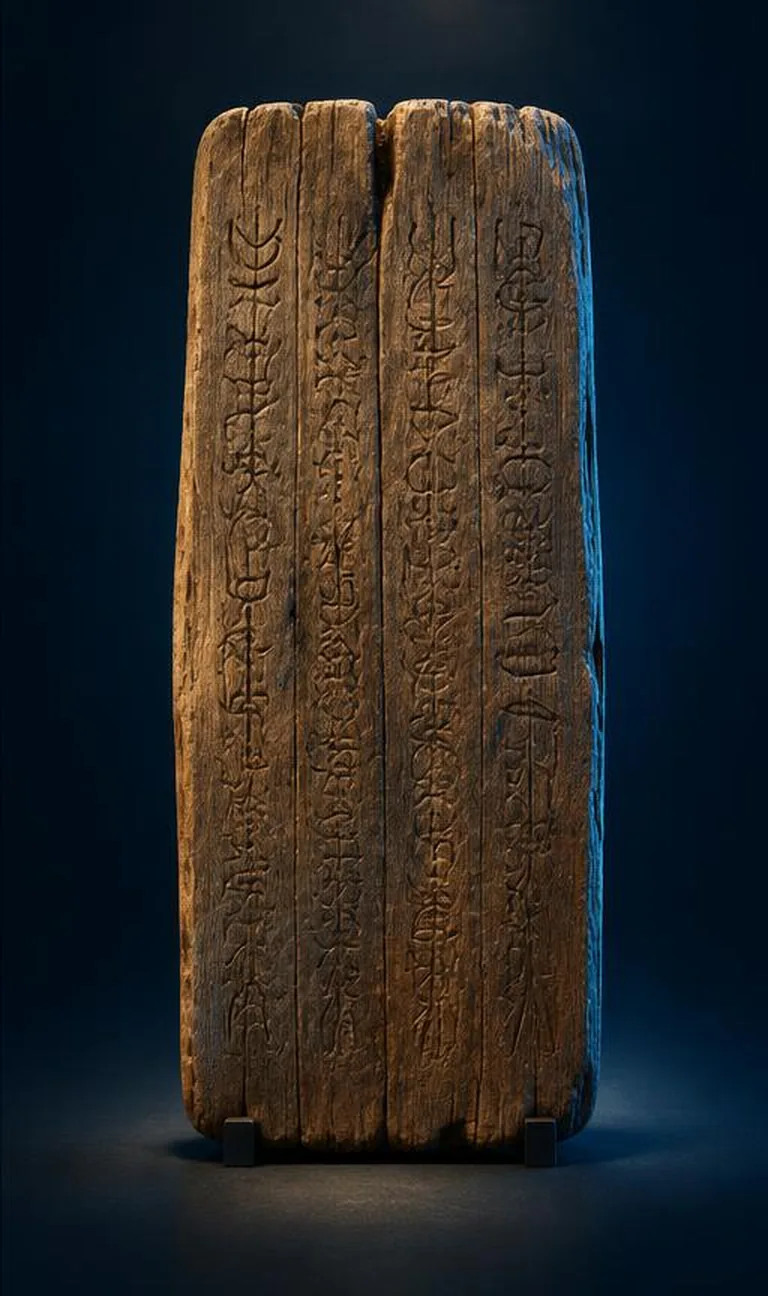
- A system of glyphs carved on wooden objects from Rapa Nui (Easter Island). About two dozen inscribed objects survive in collections worldwide. The lines are written in reverse boustrophedon: the reader turns the object at the end of each line.
- Has Rongorongo been deciphered?
- No. Whether it encodes language as true writing or serves as another kind of record is still debated. The most widely discussed partial result is a sequence on the Mamari tablet that several scholars interpret as a lunar calendar, but even that reading is not universally accepted. A 2024 radiocarbon study (Ferrara et al., Scientific Reports) dated the wood of one tablet held in Rome to before European contact, which bears on whether the script was invented independently.
- Why is it so difficult?
- The corpus is small, many objects are damaged, the tradition of reading was lost in the nineteenth century, and there is no bilingual text. Any proposal therefore needs strict controls against overfitting.
- What is VALEXII's approach?
- Original, unverified hypotheses: work from accurate 3D/record-level corpora, test calendar-constrained alignment with frozen values, and check whether patterns transfer to held-out lines. No translation is claimed.
Sources and further reading
- Ferrara et al. (2024), “The invention of writing on Rapa Nui (Easter Island). New radiocarbon dates on the Rongorongo script,” Scientific Reports 14:2794
- Lastilla, Ravanelli, Valério & Ferrara (2019), 3D modelling of the Mamari tablet, ISPRS Archives XLII-2/W18 (University of Bologna, ERC INSCRIBE)
- Rongorongo — encyclopedia overview (general background only)
External sources are independent of VALEXII.AI and do not endorse this work.