FICTIONAL DOSSIER
Oilfield operations
- Invoice
- Signed field ticket
- Approved rate
- Equipment / hour reconciliation
- Invoice
- $28,750
- Documented field ticket
- $25,000
- Documented total
- $25,000
- Provisional variance
- +$3,750
Human review: HOLD
 Revenue intelligence
The revenue you've earned deserves to be collected. The work you've done deserves to be proven.
Revenue Intelligence & Audit Readiness · From dispatch to field proof to invoice review.
Your crews, dispatch, tickets, invoices, spreadsheets and accounting already tell the story of your business. DISPATER helps bring those pieces together—so you can discover discrepancies earlier, prepare stronger evidence packages, and turn operational complexity into decisions you can defend. Two proposed packages: oilfield service and towing/recovery. Keep the tools you trust; connect the work that matters.
Proposed managed service in discovery pilots—not a deployed customer CRM or independently validated platform.

Reporting framework
NOW
What the records show today.
CHANGED
What moved since the last review.
NEXT
The proposed bounded follow-up.
WHY
The reasoning and its limits.
PROOF
The source evidence behind each statement.
Development note: synthetic tests have demonstrated portions of this workflow, while independent real-company validation remains an upcoming milestone. Synthetic exposure estimates are not recovered customer revenue.
01 · PLANNED
Relate equipment logs, field tickets, contracts, invoices and payments around the work and its source evidence.
02 · PLANNED
Evaluate parsing tools for document structure, provenance and explicit unknowns.
03 · PLANNED
Compare authorized records at scale with reproducible calculations and bounded processing.
04 · PLANNED
Surface candidate discrepancies for human review, not autonomous financial approval.
05 · PLANNED
Design ongoing authorized ingestion and evidence freshness checks; no live monitoring claim.
06 · PLANNED
Explain findings using supporting records, uncertainty and independent verification.
PLANNED EVIDENCE WORKFLOW
INGEST → CONNECT → RECONCILE → DETECT → VERIFY → EXPLAIN
Equipment logs → field tickets → contracts → invoices → payments: connected source references are intended to make each proposed finding reviewable. No autonomous approval, payment or guaranteed recovery.
Review the dated engineering snapshotContractor documentation · Proposed managed service
When you're preparing paperwork for an enterprise customer with the scale and standards of ExxonMobil or Shell, finding the right support documents should not become another full-time job. DISPATER is designed to help teams assemble traceable, reviewable records from the apps they already use.
Field tickets, signatures, purchase orders, approved rates, dispatch records, invoices, maintenance records and supporting audit evidence—organized around the work and the person reviewing it. Authorized access and source references are part of the proposed pilot scope, not a claim of a deployed integration.
ExxonMobil and Shell are examples of enterprise scale only—not claimed customers, partners or endorsers. Requirements vary; confirm them with each customer. Contract compliance is not guaranteed.
Discuss your documentation workflowHow it could look
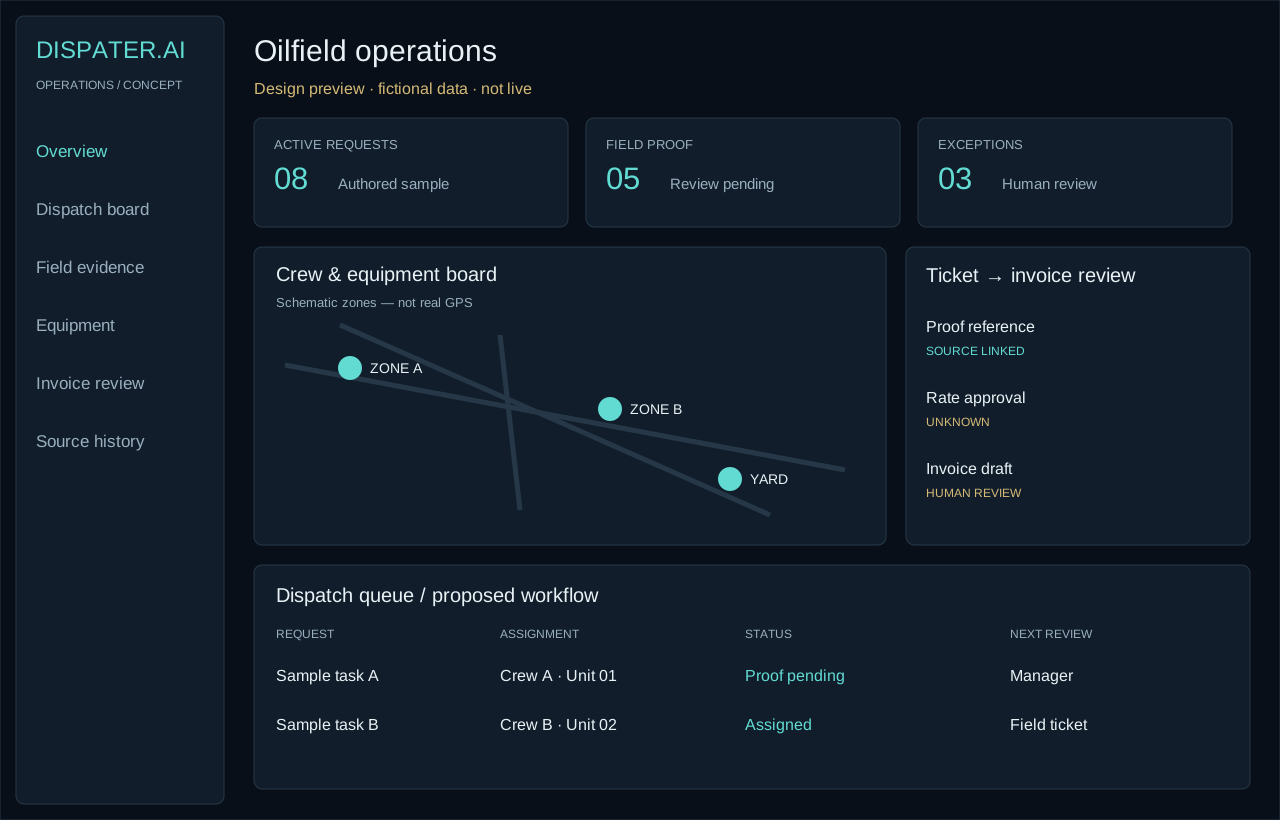
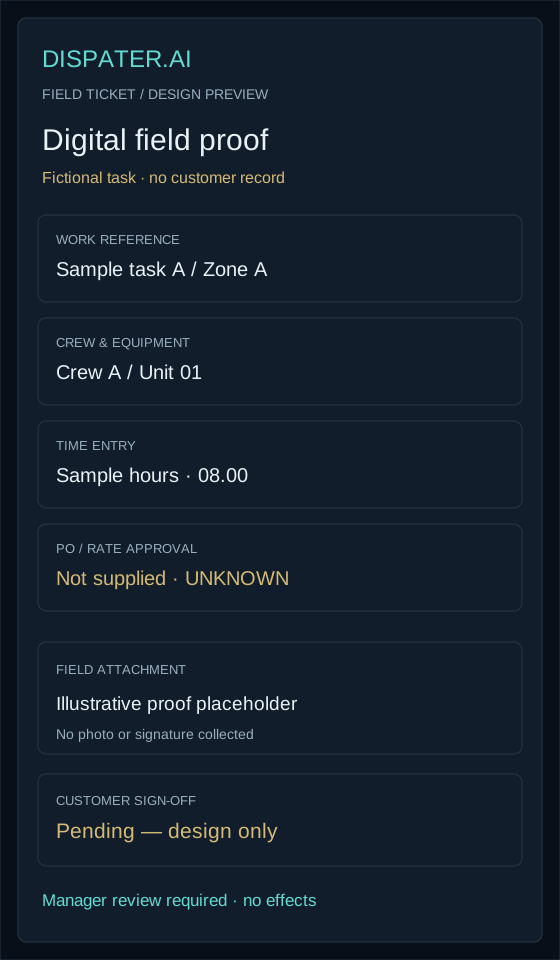
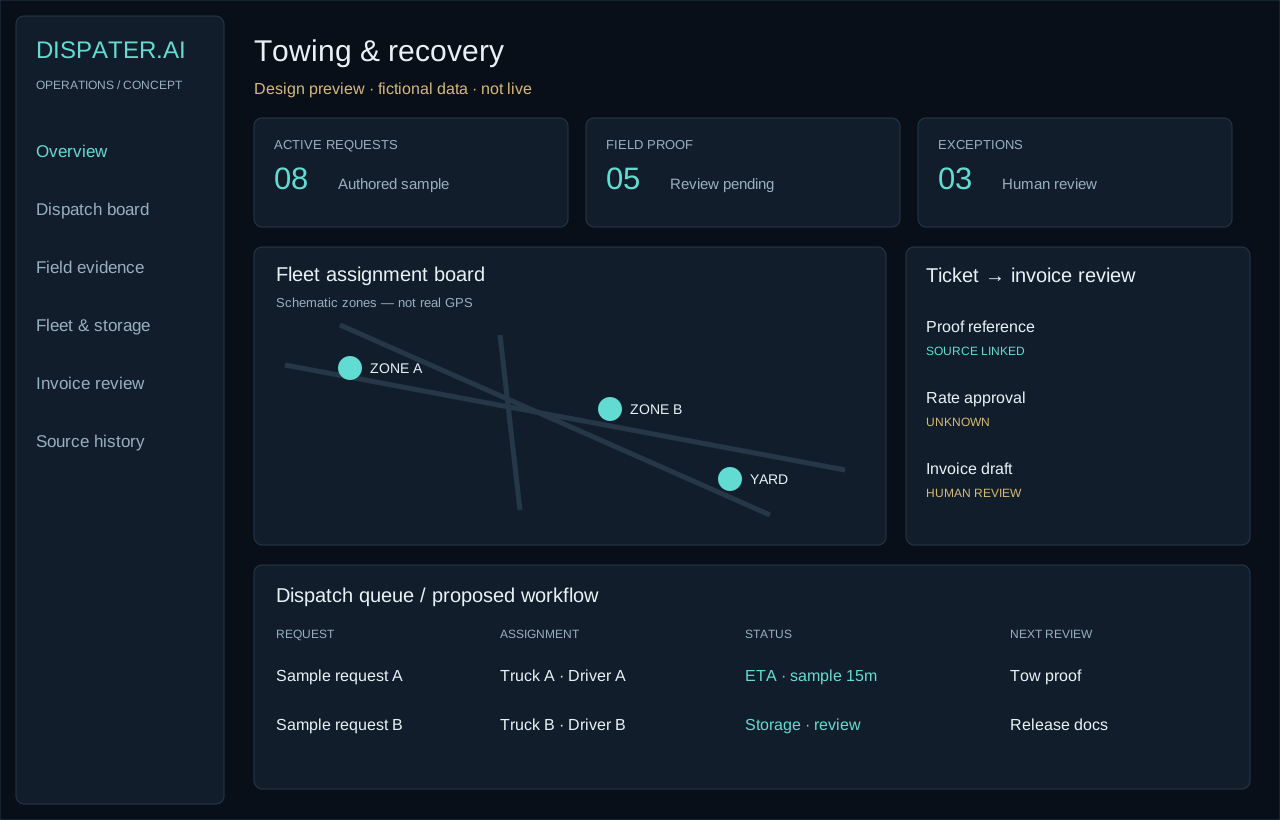
Hypothetical scenario · not a customer case
Real-world recordkeeping lessons · Official sources
Separate from our hypothetical Friday scenario, these public sources explain why substantiation and accessible supporting records matter. They do not demonstrate DISPATER performance.
IRS · Historical Taxpayer Advocate report · 2002
The report describes Franklin v. Commissioner: no documentary support was offered for deductions beyond amounts the IRS allowed, and the taxpayer said records were scattered. In Newhouse v. Commissioner, the taxpayer said he had not kept detailed automobile logs or brought detailed records. These are historical substantiation lessons—not DISPATER customer outcomes or predictions about an audit.
Read the historical IRS reportIRS · Examination guidance
The Internal Revenue Manual describes records sufficient to establish reported income, deductions and credits, and procedures for inadequate-records notices. Determinations are case-specific; organizing documents does not guarantee acceptance of a deduction or satisfaction of a notice.
Read IRS examination guidanceFMCSA · Enforcement mechanisms
FMCSA explains that enforcement cases may follow compliance reviews, complaint investigations, terminal audits, roadside inspections or other investigations. This describes official enforcement mechanisms, not a named carrier case or a claim that DISPATER prevents penalties.
Read FMCSA civil penalties guidanceFMCSA · Hours-of-service supporting documents
FMCSA identifies categories including trip and dispatch records, relevant expense receipts, fleet communications and payroll records as supporting documents for driver duty-status records. Applicability and required details must be checked for the operation; a dashboard is not proof of regulatory compliance.
Read FMCSA supporting-document guidanceEducational only—not legal or tax advice, audit certification or a guarantee. DISPATER and VALEXII.AI are not affiliated with the IRS, FMCSA or any government agency. Confirm current requirements and applicability with qualified advisers.
DISPATER.AI · INDUSTRIAL EVIDENCE REVIEW · PILOT DESIGN
Oilfield and towing/recovery pilot design · synthetic examples · no customer upload enabled. Audit preparedness, not certified auditing, live model inference or a deployed customer portal.
DISPATER.AI is the proposed managed operations service; AUREX/OX is the underlying intelligence and bounded-workflow design. Together, the aim is to make field records, exceptions and invoice preparation easier to review.
Designed to surface unbilled work, missing labor, equipment or material revenue, and underbilling against field records.
Designed to challenge vendor overcharges, duplicate invoices or payments, and rates that differ from the contract.
Planned source-linked field tickets, signed approvals, contracts and rate books, invoices, timesheets, payments, general ledger, exceptions and reviewer decisions. Evidence packets accumulate over time; missing records remain visible.
Extraction and explanation with versioned snapshots and held-out testing—not live inference, live training or financial authority.
One reconciliation and evidence core, with segregated tenant data by design—not an implemented customer portal. Pre-alpha foundations and synthetic research do not establish deployed financial capability.
Oilfield: compare crew and equipment records, field-ticket signoff, PO and approved rates. Towing/recovery: compare dispatch authorization, tow proof, loaded mileage and storage records. Missing documents or approvals stay unresolved—not zero and not safe. Live Railway integration for these industrial workflows is NOT VERIFIED; transport checks are not proof of a connected CRM or audit service.
Evidence → Qualification → Reality → Authority → Effect
Financial authority: HOLD · Human review required. Audit-ready does not mean a certified audit, an audit opinion, or guaranteed regulatory compliance.
FICTIONAL DOSSIER
Human review: HOLD
FICTIONAL DOSSIER
Human review: HOLD
Potential efficiency gains — illustrated, not promised
Every assumption is yours to change. The percentages below are planning inputs, not study results or industry statistics.
$21,840/ year capacity value
6 × 5 h = 30 h/week × 40% = 12 h/week × 52 = 624 h/year × $35. Labor capacity, not guaranteed cash savings.
$2,000/ month worth reviewing
400 × 2% = 8 tickets × $250. Review exposure, not recovered revenue or a forecast.
3.33 h/ month reviewing · $1,400 / year labor exposure
400 × 2% = 8 exceptions × 25 min = 200 min/month ÷ 60 = 3.33 h × $35. Estimated time and labor exposure only—not savings or a forecast.
Illustrative planning scenarios. Results vary. Savings, revenue recovery and regulatory outcomes are not guaranteed.
VALEXII.AI company services
Start where work meets revenue, then organize the records and connect the systems. This order is an editorial assumption about initial purchase urgency—not measured customer demand. All ten offerings are proposed and scoped individually.
Every ticket tied to the job, the rate and the invoice.
Dispatch, crews, equipment, digital field tickets, PO and rate verification, invoice draft preparation and job-cost clarity.
Discuss your workflowNo tow should go unbilled because the paperwork wandered off.
Dispatch, driver assignments, tow proof, motor-club paperwork, impound and storage documentation and missing-billing checks.
Discuss your workflowFrom twelve versions of the truth to one you can explain.
Consolidate messy workbooks, clean and deduplicate data, repair formulas, build templates, pivots and reporting, convert spreadsheets to dashboards and keep versioned change history—so nobody copy-pastes the same row twice.
Discuss your workflowFind the ticket, the PO and the invoice in seconds, not afternoons.
Consistent naming, searchable structures, controlled access, document intake, PO/rate-sheet/ticket/invoice matching, receipts and source provenance.
Discuss your workflowKeep the tools you trust. Connect the work that matters.
CRM, accounting, QuickBooks-style ledgers, dispatch, telematics, field tickets, invoicing, file repositories, email and Excel—through documented APIs, CSV export/import or approved Make/Zapier-style connectors. Compatibility depends on available APIs, permissions and agreed scope; no universal plug-and-play promise.
Discuss your workflowWalk into the accountant's office organized.
Organize bookkeeping support, source evidence, reconciliations, completeness checks and accountant-ready packages. Preparation support only—not tax advice, audit certification or a guaranteed outcome.
Discuss your workflowKnow which driver, vehicle and inspection files are complete—and which are not.
Driver, vehicle, inspection and service-related documents, maintenance and operational evidence, gaps and follow-ups where applicable. Separate from IRS work. Not legal assurance, compliance certification or a guarantee.
Discuss your workflowPortals and dashboards your team actually wants to open.
Frontend and backend design, modern dashboard UX, customer and crew portals, secure APIs, database and workflow architecture.
Discuss your workflowAn assistant that answers from your approved knowledge—and shows its sources.
Permitted Qwen or other model integration, model routing, retrieval over approved documents, governed copilots, document search and evidence-aware explanations with people in control. Provider connections are configured per pilot; none are live by default.
Discuss your workflowStart with one painful workflow. Prove it. Then expand.
Scoped discovery and managed pilots. Managed multi-location projects may be quoted from approximately $3,000/month depending on integrations and support—indicative, not a flat price; smaller businesses are quoted individually and third-party fees are separate.
Discuss your workflowUnder the hood
AUREX/OX is the evidence and review infrastructure research DISPATER pilots could build on. The public tour uses synthetic samples only.
Private repositories exist, as reported by the project owner; their functionality has not been independently verified. This public page is a developmental direction, not proof of a deployed operations platform, live dispatch, certified auditing or autonomous control.
Not independently validated or commercially deployed.
Exploring operational integration instead? DISPATER.AI — Oilfield Operations is a planned custom pilot service, not a deployed customer CRM.
Historical name / Dis Pater was a Roman god of the underworld and hidden riches beneath the earth, later associated with Pluto. The name is a cultural reference to what lies below the surface—not evidence of technical capability.
Context
Planned comparison of dispatch records, tickets and signoffs. Missing documents remain visible and unresolved; synthetic findings do not prove a live audit capability.
ExploreObservation
Compare approved rates, PO scope, labor, mileage, equipment and storage evidence. Candidate discrepancies require human review; no automated billing or payments.
ExploreDecision support
Proposed evidence packets and invoice drafts support audit preparedness—not certification, an audit opinion or guaranteed regulatory compliance. Live Railway integration is NOT VERIFIED.
ExploreA DISPATER domain adapter would qualify source and calibration context, challenge interpretations, and check local operational permissions before bounded recommendations. No resource discovery, machinery control or verified environmental outcome is claimed. Functionality remains unverified.
The aim is simple: know the source, test alternative explanations and keep permission separate from persuasion. Independent checks must support consequential claims. Approval must be current, limited in scope and withdrawable before an action—not after it.
EVIDENCE → QUALIFICATION → REALITY → AUTHORITY → EFFECT
What was observed?
Can we rely on it here?
What is supported?
What is permitted now?
What happened within bounds?
A past observation stays in the record. A present action needs current, scoped authorization. Missing, stale or unverified evidence never counts as PASS. UNKNOWN ≠ SAFE.
Independent support must be demonstrated, not assumed from agreement between models. Unresolved checks mean HOLD → human review. ORB MOTION AUTHORITY = NONE; colors, wheels and zoom provide presentation only.
DESIGN INTENT / DEVELOPMENTAL · This public explanation does not establish operational gates, independently verified product performance or autonomous authority.
The design explores transferable cognitive state—structured context, evidence references, uncertainty and review history—across BCXMET cybersecurity, DISPATER industrial intelligence and XAITA capital intelligence. Each domain shell retains its own evidence, permissions and authorities. Cross-domain transfer is a developmental ambition, not verified functionality.
Remembering a source or an unresolved question could make a new review more useful. It must not silently carry approval into another setting. This is not a claim of sentience or autonomous agency, and continuity is not verified functionality.
Evidence → Qualification → Reality → Authority → Effect
The system must never be its own sole witness. Independent evidence and challenge must support consequential claims; unresolved evidence remains HOLD for human review. UNKNOWN ≠ SAFE. Missing or stale evidence is not PASS. Visualization supplies no authority, and no shell inherits another domain’s authorization.
Explore governed intelligenceExplore an oilfield or towing/recovery workflow, agree on permitted sources and define what a human-reviewed pilot would need to demonstrate.