VALEXII Research / Voynich · HOLD
Voynich Manuscript: patterns before meaning.
Research in progress — not a claimed decipherment. The manuscript invites explanations; our work tests transcription, boundaries, local order and historical hypotheses. The current position is HOLD: a compatible pattern is not an identified language, and no blind held-out semantic prediction has established a translation.
01 / Corpus control
Preserve transcription and source identity
02 / Structure
Test segmentation, local order and matched nulls
03 / Reconstruction
Held-out prediction, reverse encoding, replication
Semantic status: HOLD / NOT ESTABLISHED · Evidence attachment required
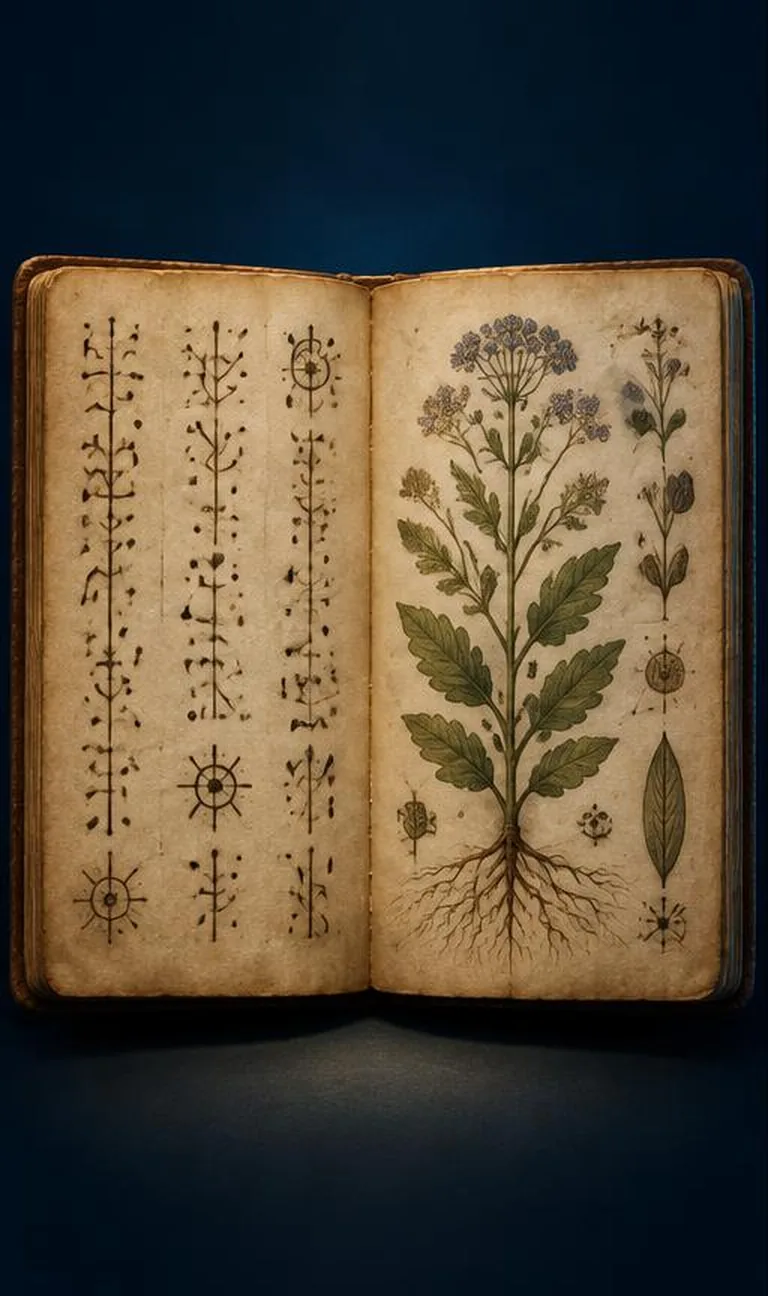
Method / No meaning without reconstruction
Reproducible structure before interpretation.
Compare reliable transcriptions and matched random baselines. A proposed meaning must predict unseen material, decode and reconstruct consistently, and survive independent replication.
DiagramState + LabelState → Record is a working refinement, not a decoded historical reading.
Neutral architecture / working model
- 01Underlying record
- 02Page / register operation
- 03Context / state
- 04Encoding grammar
- 05Multi-glyph components
- 06Local relational order + layout
- 07Visible Voynich surface
Milestones / not a percent decoded
A plausible key is only a beginning.
These stage labels describe current research posture, not a total percentage or a verified translation.
Boundary / segmentation structure
Line / state structure
Cross-transcription replication
Component / relational modeling
Held-out prediction
Semantic anchors
Continuous plaintext
Reverse reconstruction
Independent replication
Internal / pre-publication / evidence attachment required
Signals worth testing, not a decipherment.
The numerical findings below were supplied as prior internal reports; supporting artifacts are not attached to this website project. They are not independently verified here.
Cross-transcription
Prior work reported 5,214 shared loci across transcriptions.
Zodiac labels
Prior work reported 298 common label loci; 189 exact sequences (63.42%), mean character similarity 0.92651, and 279/298 (93.62%) in the same coarse first-token family.
Rosettes
Prior work reported local-order signal above within-region shuffle nulls across several character n-gram representations.
Currier B
Line/state and graded-boundary structure remain active research directions.
Solution-space reduction
A failed key is useful evidence.
Simple astronomical cribs, naive zodiac/pharma shared vocabulary, absolute-coordinate models, simple zodiac ring-state mappings, fixed degree/decan keys and related shortcuts have been weakened or falsified in internal work. Reassessment requires attached protocols and artifacts.
Versus the field
Compare milestones, not rankings.
Transcription control, null comparisons, held-out prediction, reverse reconstruction and independent replication are the comparison criteria. An evidence-backed global ranking or percentage comparison is not established; no #1 claim is made.
Voynich Manuscript · background
Voynich Manuscript: frequently asked questions
- What is the Voynich Manuscript?
- An illustrated codex written in an unidentified script, held at Yale University's Beinecke Rare Book & Manuscript Library as MS 408. Radiocarbon testing of its vellum points to the early fifteenth century. Its sections are commonly described as herbal, astronomical, biological, cosmological and pharmaceutical.
- Has the Voynich Manuscript been deciphered?
- No decipherment has been accepted by the scholarly community. Many proposed solutions have been published; none has produced readings that independent researchers can reproduce across the text.
- Can I see the manuscript myself?
- Yes. The Beinecke Library provides full digital images of the manuscript, linked below.
- What is VALEXII researching?
- Computational structure: transcription control, segmentation, line position and comparison against matched null models. These are working hypotheses with evidence attachment required—not a translation. Research in progress — not a claimed decipherment.
Sources and further reading
- Beinecke Rare Book & Manuscript Library — The Voynich Manuscript
- Voynich manuscript — encyclopedia overview with scholarship references
External sources are independent of VALEXII.AI and do not endorse this work.
Related tracks
One discipline. Distinct scripts.
Voynich, Linear A and Rongorongo have active research directions. None has a verified translation here.